
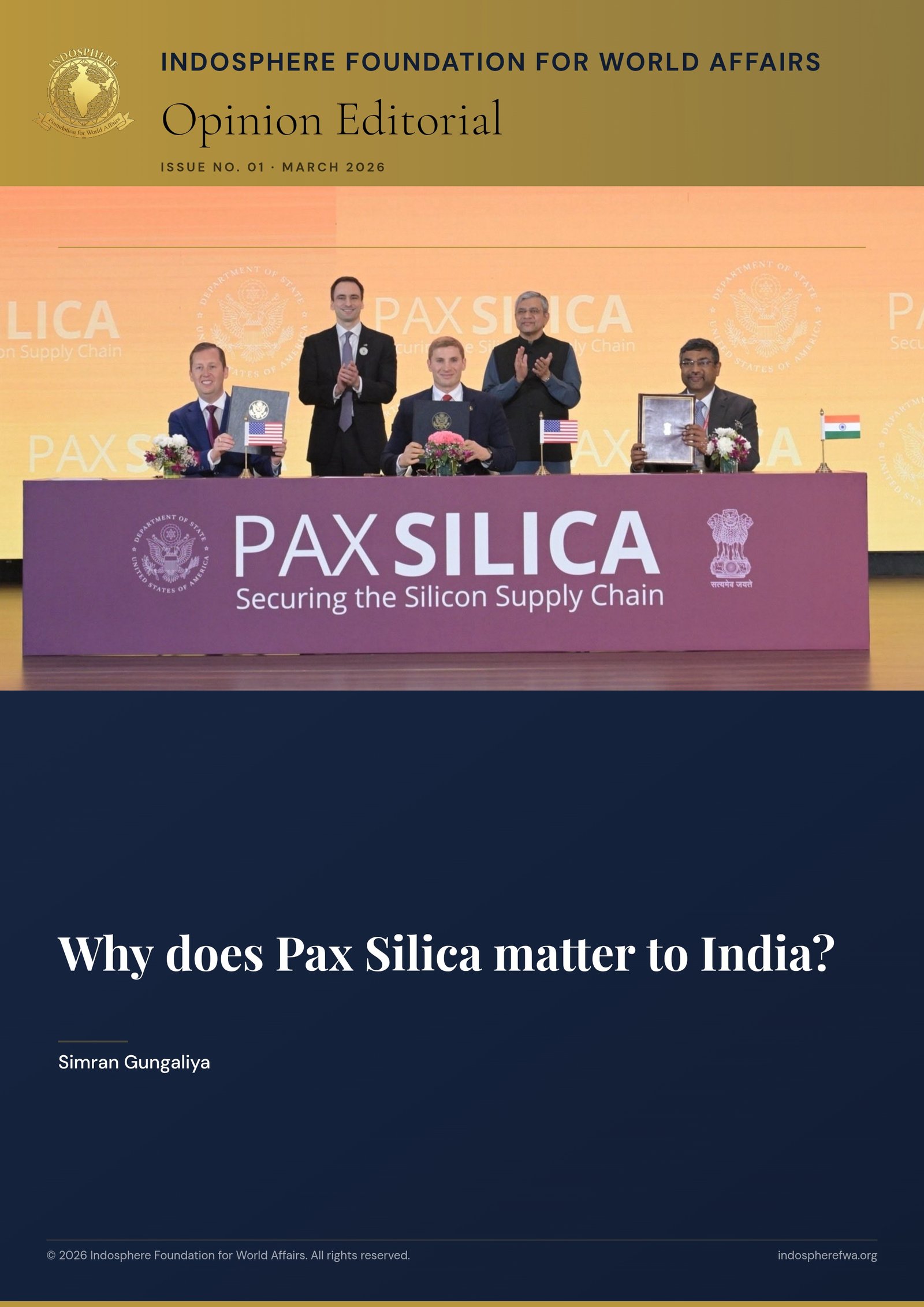
India has formally signed the U.S.-led initiative Pax Silica. If the 20th century was forged on oil and steel, the 21st century is being engineered by semiconductors, critical minerals and artificial intelligence. India’s entry is not just symbolic but necessary and strategic. It is a US-led international strategic initiative to create secure, resilient and trusted global supply chains for critical minerals, semiconductors and artificial intelligence. Launched on 12th December 2025 at Washington DC . The literal meaning of ‘Pax’ in Latin is 'peace', and 'silica' is a key compound crucial in manufacturing electronics such as semiconductors, chips, and fibre optics. Thus, together they mean to promote peace and growth.
According to Jacob Helberg (Secretary of State), Pax Silica is aimed at bringing friendly and trusted countries together to reduce coercive dependencies and product materials and capabilities foundational to artificial intelligence and wants to ensure that nations with the same interest can align and develop together. This initiative aims to counter China’s dominance in new-age sectors such as critical minerals and artificial intelligence that has created a wide gap in the price points of Chinese products and those produced elsewhere, but its sole focus is not only on countering China but also on developing its own network to secure supply chains.
The Formal Signatories include USA, Japan, Republic of Korea, Australia, Singapore, the Netherlands, United Kingdom, Israel, United Arab Emirates, Qatar, Greece and India. Together, these countries are home to the most important companies and investors powering the global AI supply chain and are hubs for critical minerals. The United states is lead architect and convener. Japan contributes advanced manufacturing equipment and semiconductor materials. The Republic of Korea is a hub for memory chip production. Australia provides critical, resource-rich anchor like lithium and rare earth. Singapore plays an important role in semiconductor fabrication and logistics. The Netherlands leads through Advanced Semiconductor Materials Lithography (the world's leading manufacturer of advanced lithography systems). United Kingdom is a significant player in semiconductor design (Advanced RISC Machines). Israel contributes specialised research and development AI software, defence technology, and specialised R&D. United Arab Emirates (UAE) and Qatar provide strategic energy resources, sovereign wealth and funding data infrastructure. Greece serves as a logistical hub for importing American liquefied natural gas (LNG) to Europe.
India stands out as a vital alternative manufacturing base and skilled human capital. In addition to formal signatories, observers countries that will attend summits and collaborate and contribute on specific projects but have not signed the declaration yet. OECD contributes as an advisory guest on economic impact. European Union (EU) participates in discussions on various issues but has a separate industrial policy. Canada contributes through research hubs for artificial intelligence and critical minerals (rare earth minerals). Taiwan remains an observer to manage the complex geopolitical sensitivities with its neighbour China. Though it has advanced chip manufacturing, it is still only an observer due to sensitivities.
For India Strategic gains are substantial. Technology is the new oil for the 21st century. In today's world, power flows through semiconductors, data and technology. Global semiconductor supply chains have proven vulnerable for various reasons, like pandemics or geopolitical tensions. India ensures it is inside the technological supply chain architecture and gains more predictable access to critical inputs. Recognition of India’s potential: Membership allows India to shape frameworks on AI chips, digital trade, data security and export frameworks instead of merely complying with the norms later. Capital and capability attraction, for India’s semiconductor ambitions, this alignment will accelerate fabrication units, R&D centres, and design ecosystems. Investors follow signals. Joining Pax Silica signals the use of advanced technology. Reduce reliance on China, for a long time, the world was dependent on China for energy resources; now that India has joined Pax Silica, it will serve as a hub for AI and technology. India offers unmatched human capital, providing 20% of the world's semiconductor design talent.
However the participation is not without challenges. Technology alliances rarely remain purely economic. India’s ability to independently engage with non-member states in sensitive tech sectors could narrow. Geopolitical retaliation, India could face indirect economic pushback if countries like China interpret Pax Silica as a strategic containment framework. India might absorb spillover costs beyond the semiconductor sector. Policy volatility in the United States India’s alignment within Pax Silica leads to mutual interdependence with the United States. However, recent political developments under Trump’s administration have led to questioning of USA credibility – sudden tariff escalations and withdrawal from multilateral agreements. Concern is not ideology but predictability. Risk of structural dependence, Semiconductor ecosystems are hierarchical. If India remains focused only on fabrications and assembly while design IP and R&D stay concentrated elsewhere, it may impact the overall development of India in artificial intelligence.
The formal induction of India into Pax Silica is a decision firmly rooted in realpolitik. While India must aim for atmanirbharta in the long run, it must pragmatically ally today to secure access to essential intellectual property, critical equipment and sustained investments. Yet in a turbulent order defined by economic coercion, a seat at the table is only the beginning. For India, Pax Silica is about striking a delicate balance between technological sovereignty and integration, not just about joining another strategic bloc. India cannot afford technological dependency or isolation at a time when export controls are forming geopolitical hierarchies and global supply chains are being weaponised. Technology is no longer a neutral field, as evidenced by the pandemic-related shortages of semiconductors, the tightening of U.S. export restrictions on China, and the escalating competition over rare earth minerals.
In conclusion, for India, which wants to be a dominant force rather than merely a balancing force, sovereignty in the digital age refers to the ability to create, develop, and safeguard its own technological future. Although Pax Silica provides access, funding, and cooperation, the more fundamental Indian question is still whether partnerships can hasten self-reliance without undermining autonomy. The answer will depend on how New Delhi uses this alignment to strengthen domestic R&D, develop indigenous design capabilities, and make sure that India is not merely assembling but also architecting the future, not on the declaration signed in Washington.
Disclaimer: These are the personal opinions of the author.