
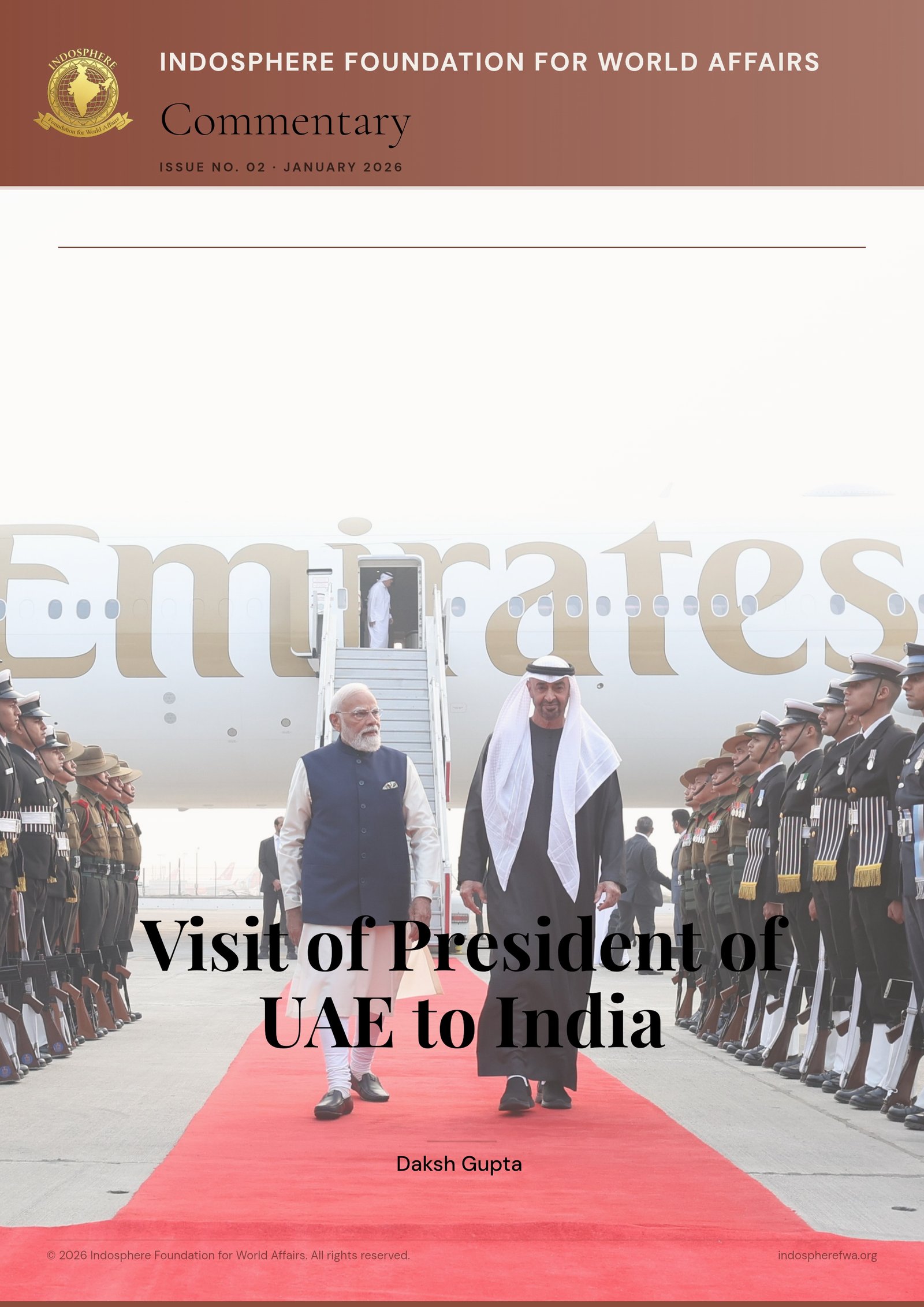
Sheikh Mohammed Bin Zayed Al Nahyan, President of the United Arab Emirates (UAE), arrived in New Delhi, India, on January 19, 2026 for a brief visit following an invitation from Prime Minister Narendra Modi. Not only does this trip illustrate the development of a rapidly expanding multi-faceted relationship between the two countries, but it is Sheikh Mohammed's third trip as President of the UAE to India, as well as his fifth visit to India within ten years. This reflects the continued growth of diplomatic, economic and strategic relations between both UAE and India.
A Welcoming Gesture Symbolising Trust and Warmth
Sheikh Mohamed bin Zayed obtained a special welcome at the International Airport in New Delhi upon arriving on the evening of January 19th, 2023. Prime Minister Narendra Modi personally received the Abu Dhabi ruler upon his arrival to break with custom and establish a personal relationship between the two men. The welcome showed the strength of the India-UAE relationship and the mutual esteem in which the two leaders held each other. In addition to the arrival at the airport, both leaders travelled together from the airport to their hotel further showing the level of trust and cooperation between the two men. Although the visit to India was brief (official reports indicate only a few hours at the time), it was productive with several items being concluded during and immediately after the visit. Several commentators on social media noted that the speed at which this diplomatic mission was executed was an example of “fast-track diplomacy” and they were interested in better understanding the reasons behind the incredibly brief yet intense diplomatic expedition.
Strengthening Economic and Trade Ties
The main purpose of the talks held between Prime Minister Modi and Sheikh Mohamed bin Zayed is focused on developing a shared economic vision. The two countries have committed to increasing bilateral trade from roughly US$100 billion to US$200 billion a very ambitious goal for both sides, as they are confident that their strong economic ties will yield positive results. As part of this effort, India has entered into a long-term liquefied natural gas (LNG) supply agreement with the Abu Dhabi National Oil Company Gas (ADNOC Gas). Under the terms of the agreement, ADNOC Gas will sell 0.5 million metric tons of LNG per year to Hindustan Petroleum Corporation Limited (HPCL) for a period of ten years starting in 2028. This arrangement on the one hand provides additional measures to secure India’s energy security and the on the other demonstrates the growing presence of the UAE as a reliable energy partner to India. During Prime Minister Modi’s visit to the UAE, a number of trade agreements were also signed that included memoranda of understanding (MOU) regarding agriculture export facilitation and specifically cover many issues related to food safety and technical standards. These MOU's will work together to enhance trade in agricultural products between both countries as well as help to improve India’s overall export strength in the agricultural sector and provide food security for the UAE.
Advancing Strategic Defence Cooperation
The signing of a Letter of Intent (LoI) to establish a Strategic Defence Partnership was one of the primary components of the visit. Both the United Arab Emirates (UAE) and India will benefit from this framework as there will be increased collaboration on defence. Defence collaboration will involve: joint manufacturing; technological exchange; cyber security; training; and counter terrorism operations; and will allow India and UAE to share technological capabilities between nations. The defence aspect of the India-UAE Partnership has moved from a limited form of cooperation (joint military training; exercises and consultations) to a more formal and durable form of Strategic Alignment. As a result of the rapidly evolving geopolitical environment in the Middle East and South Asia, both India and the UAE have identified defence cooperation as one of the primary means to create regional security and stability.
Energy, Technology, and Innovation Partnerships
India and the UAE have been exploring ways in which they can work together to develop partnerships in the civil nuclear energy sector, in addition to working together in traditional hydrocarbon energy markets. As a result of the new legislation in India allowing, for the first time, private developers to invest in the nuclear power generation industry, it is anticipated that this new partnership will lead to the establishment of joint venture agreements to develop advanced nuclear technologies, such as Small Modular Reactors (SMRs). In addition, India and the UAE discussed the establishment of a new partnership in the area of digital technology and innovation. As a result of these discussions, both countries have agreed to look into the possibility of establishing a "Digital Embassy," which would serve as a secure digital data repository and would be viewed as being located within the country of origin with respect to data protection and privacy. This initiative is part of India's larger efforts to improve its digital resilience and position itself as a leader in technology. Most importantly, the leaders of these countries planned to establish a supercomputing cluster in India through a collaborative effort between the Centre for Development of Advanced Computing (C-DAC) and G42, a UAE based company. Once the supercomputing facility becomes operational, it will enable research and development in Artificial Intelligence, Scientific Computing, and Commercial-Technology Innovation.
Expanding Space and Academic Collaboration
Space Cooperation was another focus of the delegation's visit. The Indian National Space Promotion and Authorisation Centre (IN-SPACe) and the UAE Space Agency signed MOU's to establish infrastructure to support the development of the Space Industry and create opportunities for Commercial Collaboration. These include Satellite Launch Services, the manufacture of Spacecraft, and for startup businesses. Education and Cultural Exchanges were part of the agenda of discussions during the visit. Both Nations are interested in expanding Student Mobility and increasing Student Mobility between the two Nations through Academic Partnerships. Establishing stronger academic partnerships between both countries, as well as Educational and Research Exchange Programs, will support and foster the development of future Bi-Lateral Cooperation and Investment in People-to-People Relations.
Strategic and Geopolitical Context
While the official agenda for this visit described cooperation and development, analytical commentary pointed to the significant timing of this visit, with the shifts in the geopolitical landscape of the Middle East and South Asia. There have been tensions in this region recently, particularly regarding Yemen and Iran, as well as in the wider West Asian region. As the United Arab Emirates continues to diversify its strategic engagement with India, it is also confirming India’s role as a stable partner that is capable of balancing competing interests among various powers for its own benefit and reflecting the depth of India's diplomatic capacity. The outreach to India from the United Arab Emirates is considered by a number of analysts to be a reflection of the recalibration of the United Arab Emirates' outlook on the region in conjunction with the changing relationships between many of the Gulf states and Pakistan and Turkiye. Strengthening relationships with India, which is regarded by many as one of the fastest growing economies in the world, is advantageous for both economic opportunity and for strengthening a geopolitical balance for the United Arab Emirates.
Cultural and Historical Bonds
Beyond the areas of economics and strategy, the UAE and India have very strong historical ties established through centuries of trade, migration and cultural exchanges. There are millions of Indians living and working in the UAE, which adds to the people-to-people connections between both nations that form the basis of official diplomatic relations. The visit was a reaffirmation of the commitment to create a cultural partnership between both countries by establishing a foundation for a strong bilateral relationship based on mutual respect for one another's heritage, as well as a common goal of socio-economic development.
Conclusion
Sheikh Mohamed bin Zayed Al Nahyan made a very brief visit to India on 19th January 2026. Nevertheless, the visit showcased a bold and strategic agenda that addressed not only economic goals and energy security but also defence collaborations and digital innovations. The visit has injected renewed momentum into the growing partnership between India and the UAE over the last decade. While this visit serves as a milestone in creating a strong foundation towards increasing trade to two-fold, increasing technological collaborations, and working on solutions to global issues, it is also indicative of the potential for shaping future global and regional dynamics through joint collaboration between the two countries.
The views expressed above belong to the author(s).