
What happened?
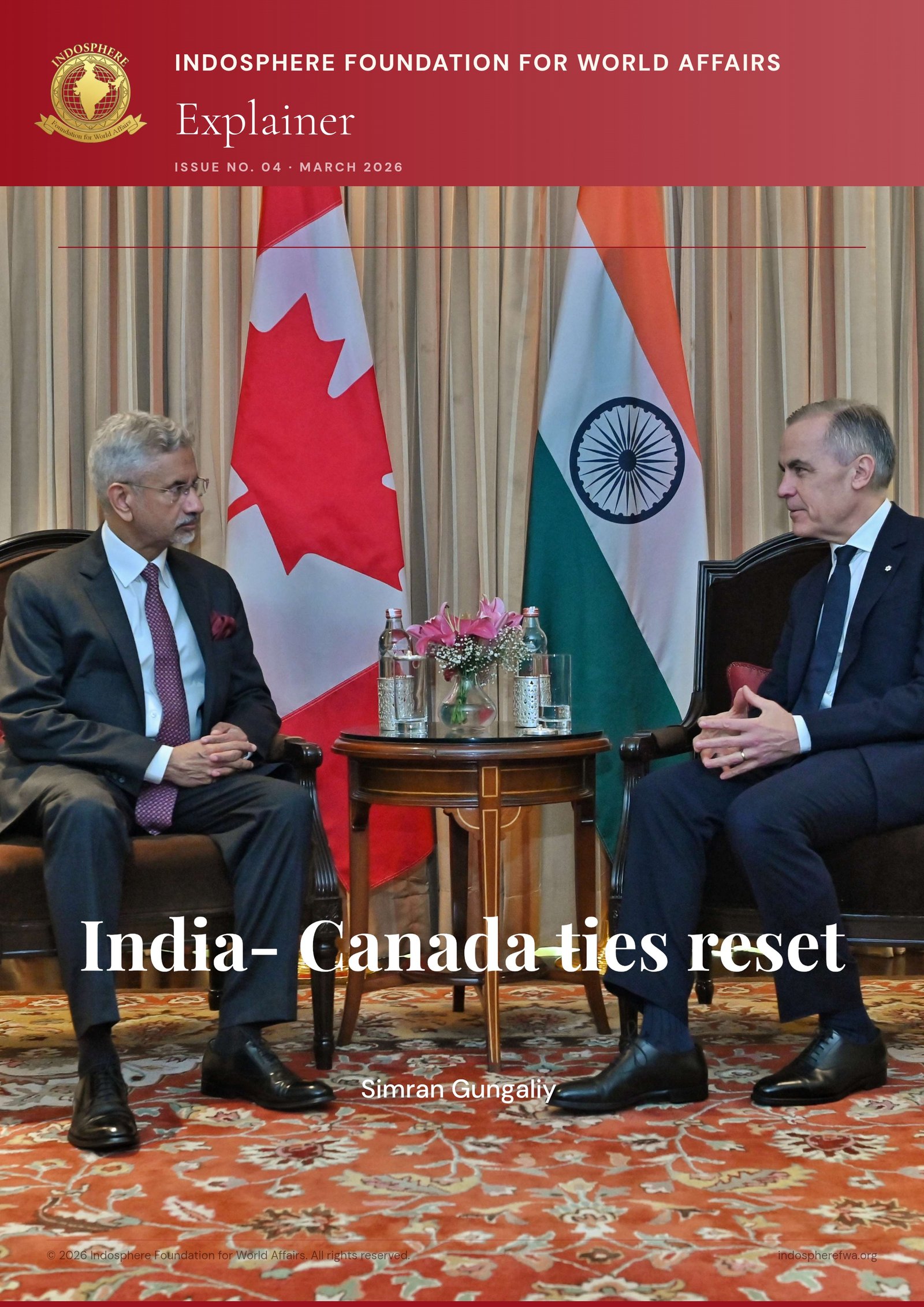
Canadian Prime Minister Mark Carney visited India for four day trip. It was his first official visit from February 27th to March 2nd, 2026. Prime Minister Modi and Prime Minister Carney had meetings to strengthen bilateral ties, economic partnership via major trade agreements and energy partnership, strategic co operations. The relations revived after two years of diplomatic tensions. The visit was one of the most significant high level between India and Canada.
Why does it matter?
The meeting signals a reset of bilateral ties between India and Canada, which had deteriorated due to political and security tensions. It also highlights the convergence of a growing geopolitical and economic partnership between two democracies in Indo-Pacific cooperation, boosting trade, defence, technology, energy and food security. Improved ties will lead to reshaping trade flows and better economic relations in the Indo-Pacific region.
Background
India and Canada share over 75 years of diplomatic relations with a deep people-to-people connection. Canada has a massive diaspora population of Indians settled in Canada numbering about 1.8-2 million people, roughly around 5% of Canada’s population, including 40% of Indian students studying in Canada each year.
However, ties deteriorated after the Canadian Prime Minister alleged the Indian government was responsible for the killing of Sikh separatist leader Hardeep Singh Nijjar in British Columbia in 2023.
Why does it matter?
The meeting signals a reset of bilateral ties between India and Canada, which had deteriorated due to political and security tensions. It also highlights the convergence of a growing geopolitical and economic partnership between two democracies in Indo-Pacific cooperation, boosting trade, defence, technology, energy and food security. Improved ties will lead to reshaping trade flows and better economic relations in the Indo-Pacific region.
Background
India and Canada share over 75 years of diplomatic relations with a deep people-to-people connection. Canada has a massive diaspora population of Indians settled in Canada numbering about 1.8-2 million people, roughly around 5% of Canada’s population, including 40% of Indian students studying in Canada each year.
However, ties deteriorated after the Canadian Prime Minister alleged the Indian government was responsible for the killing of Sikh separatist leader Hardeep Singh Nijjar in BritishColumbia in 2023.
India vehemently rejected the allegations, calling them politically motivated, and accused former Prime Minister Justin Trudeau’s government of supporting separatist activities of Sikh extremists of the Khalistani movement.
The dispute led to diplomatic fallout, suspension of visa services, expulsions of diplomats and interrupted trade negotiations. The relationship reached one of its lowest points in decades when diplomatic relations essentially stopped.
A gradual thaw began in June 2025 when both governments restored diplomatic ties. India and Canada resumed discussions on law enforcement and intelligence cooperation, and they also appointed new high commissioners.
Prime Minister Carney invited Prime Minister Modi to the G7 summit at Alberta in 2025; this laid the groundwork for bilateral trust and restarting trade negotiations. By the beginning of 2026, both the countries signalled willingness to rebuild ties apart from only having diplomatic ties.
What are the implications?
The meeting has several strategic and economic implications.
- Energy and resources are a central pillar of the relationship. Canada, which possesses large reserves of critical minerals, will supply uranium to India for nuclear power worth about $ 1.9 - 2.6 billion and collaborate on clean energy, AI talent and mineral supply chains. This strengthens the defence industry.
- Both the countries agreed on finalising a Comprehensive Economic Partnership Agreement (CEPA) to enhance bilateral trade to about $50 billion by 2030.
- Memorandums of Understanding were exchanged between officials on topics such as clean energy, critical minerals, and cultural cooperation.
- In the situation of global uncertainties, the visit of Canada's Prime Minister is a part of larger plan to diversify trade outside of the US and lessen reliance as around 75% Canada’s exports go to the United States.
What Next?
The immediate next step is to soon finalise a ‘Comprehensive Economic Partnership Agreement’ (CEPA). A trade agreement is expected by the end of 2026. It aims to boost bilateral trade to $50 billion by 2030. The deal will be negotiated and concluded by the end of the year; seek to hedge reliance on an unpredictable US administration. Both the nations aims at expansion of a strategic partnership with a new ambition, focus and foresight between two countries.
The views expressed above belong to the author(s).