
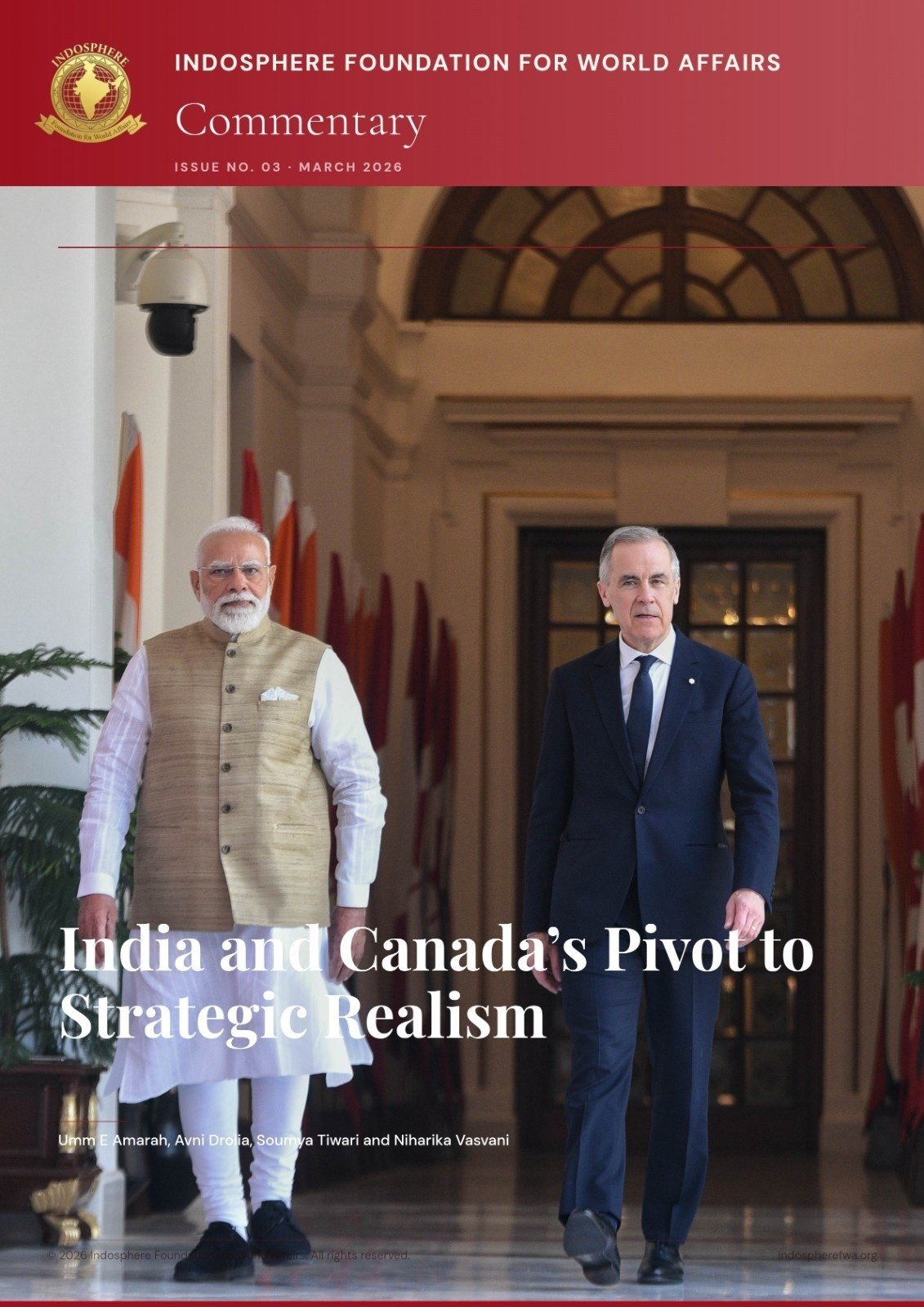
With the gates of Hyderabad House opening in New Delhi on the 2nd of March, 2026, to Canadian Prime Minister Mark Carney, the crisp New Delhi air was alive with the feeling of change. This was no ordinary meeting; this was a high-stakes comeback. After years of shoulder turns and political silence, this is a high-stakes pivot towards strategic realism. In an era when the US-Israel-Iran conflict is threatening the world’s energy and trade routes, India and Canada have come to the stark realization that they can no longer afford to be enemies. This is a pivot towards 'strategic realism', where economics is now the priority over politics.
CONTEXT
In order to understand the significance of the Carney-Modi handshake and how low the relationship had sunk, it must be understood that this is the first time in eight years that a Canadian Prime Minister has made an official, bilateral trip to India since the 2018 Trudeau trip. However, the "deep freeze" in the relationship had occurred in 2023 after the Nijjar allegations, which had sunk the relationship to an all-time low, resulting in the expulsion of diplomats and the halting of trade talks. However, the entry of Mark Carney in 2025 and the "results-first" approach he espouses was the necessary reboot for the relationship. "Results first" eliminates the emotional arguments of the past. For Carney, the relationship with India is not merely a choice, but the need of the hour. In an environment of rising prices and energy shortages because of the war in West Asia, Canada simply cannot afford to be in a cold relationship with one of the fastest-growing economies of the world.
MAIN ARGUMENT
A Foundation of Strategic Realism
The visit of the Prime Minister, Mark Carney, to New Delhi is a sign that these two countries have, at last, moved on from a relationship based on diaspora politics to one based on the principles of 'Deliverables First' diplomacy. In the process, the two countries are laying the foundation of an economic floor that is so thick and robust that it will withstand any future political tremors.
Yet, this is not just a trade correction; this is a well-calculated move towards Strategic Neutrality. In a world that is increasingly volatile and uncertain, made worse by the ongoing US-Israel-Iran conflict and the looming protectionist threat emanating from the Trump administration in Washington, this is a shield. It also makes certain that both India and Canada are able to protect their vital energy and economic interests without having to make a choice between two warring global powers. This visit also proves that for emerging power states in the modern age, economic interdependence is no longer an aspiration, but the ultimate prerequisite for sovereignty and self-preservation as a nation-state.
ANALYSIS
This "Economic Floor" is underpinned by four structural pillars, and all of this will endure for many political cycles.
Pillar I: Assets and the "Triple-A" Strategy
The roadmap for signing the CEPA by the end of 2026 is to achieve $70 billion trade by 2030. Private sector sentiment is surging, and HCL Technologies’ plan to increase its workforce in Canada by 75% is testimony to Indian industry’s faith in Canada’s stability. At the same time, Canada’s savings will be hard-wired into India’s National Infrastructure Pipeline (NIP). By locking Canada’s retirement savings into India’s highways and green energy, Canada and India have created a bond that is "too big to fail."
Pillar II: Atoms and Atmosphere
In the quest for energy security in the midst of the US-Israel-Iran conflict, a path-breaking agreement worth $2.6 billion with Cameco will provide 22 million pounds of uranium up to 2035. This "Uranium Bridge" will light up millions of homes in India with clean, green, and pollution-free energy. But this is not just about the atom; it is also about the atmosphere, with Small Modular Reactors combining Canadian know-how with Indian Panchamrit climate goals, turning the tables on energy security to a "Net Zero Synergy."
Pillar III: Algorithms and Innovation
The A.I. Corridor connecting Toronto and Bengaluru means that the McGill AI Centre in India is now a home for the corridor. Besides the health-related AI and the space exploration with ISRO, the attempt to connect the Indian UPI with the Interac system in Canada is the "personal touch" for the diplomacy to take practical form.
Pillar IV: The Living Bridge
Migration friction gave way to the concept of "Talent Mobility." PM Modi called the diaspora of 1.8 million the "human glue." As he mentioned in the CEO Forum, "Just like in T20 cricket, the ‘match-winning partnership’ requires ‘fearless strokes’ to craft the future together." As part of the Globalink Research Internship, 300 Indian researchers will now be working in Canada annually. The initiative was complemented by the 300 Canadian researchers in India with the Globalink program.
IMPLICATIONS
The first implication of the 2026 summit is the establishment of "Institutional Guardrails," which are structural shock absorbers meant to prevent another collapse, such as that which took place in 2023. By re-establishing the India-Canada CEO Forum, both nations have, in effect, outsourced their relationship stability to the private sector, ensuring that "actionable recommendations" from business leaders guide the CEPA negotiations, not "explosive political rhetoric." This is underscored by the new defense architecture, which includes the India- Canada Defence Dialogue and Defence Attachés, replacing "microphone diplomacy" with direct communication channels.
The reset relationship has important implications for the Indo-Pacific Strategies of both nations. In the context of the US-Israel-Iran conflict, both nations are seeking to become a "stabilizing center." By supporting Canada’s bid to enter IORA and their shared commitment to Maritime Domain Awareness, India is signaling Canada’s emergence as a key Pacific player.
Lastly, the Joint Action Plan on Critical Minerals establishes a “sovereign supply chain” for lithium and potash, protecting the Viksit Bharat objectives of India from worldwide price fluctuations. This “Deep Strategic Integration” unites the Canadian resources with the Indian scale, demonstrating that in the choppy waters of 2026, both nations are in the same canoe and, therefore, will paddle in the same direction to ensure their sovereignty from geopolitical tremors.
CONCLUSION
The visit of Canadian PM Carney exemplifies the end of "Microphone Diplomacy" and the beginning of Strategic Realism. By anchoring the relationship on the "Four Pillars" of Atoms, Algorithms, Assets, and the Living Bridge, the two nations have established an Economic Floor that is now too massive to be upended by political grievances.
The wounds of 2023 have been covered over by the "Institutional Guardrails" of defense discussions and CEO meetings. As the two nations move into a century of energy insecurity and technology disruption, the Carney-Modi reset ensures that even as the storms rage around the world, the Indo-Canadian relationship stands as an oasis of stability.
The views expressed above belong to the author(s).