
Background
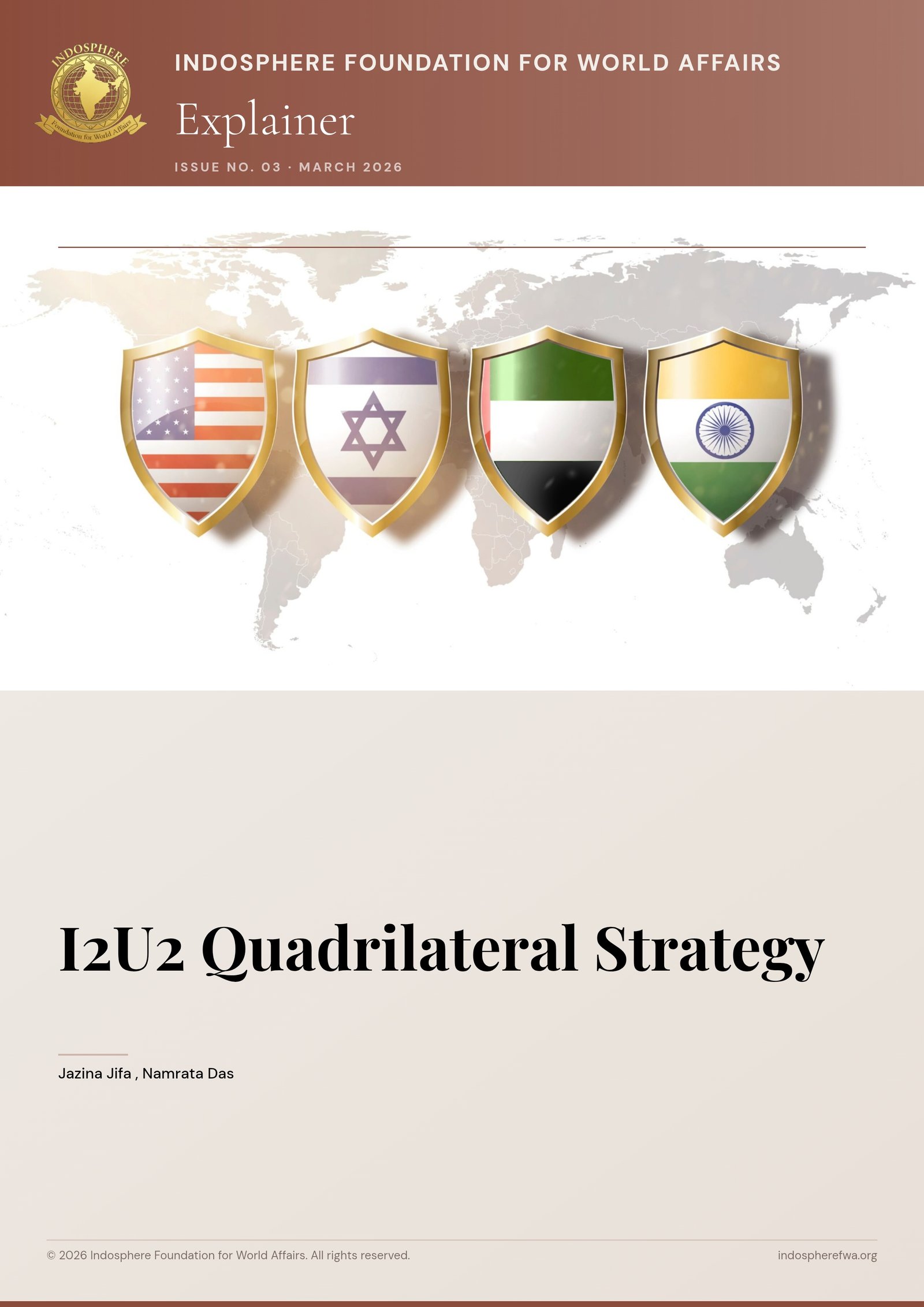
The I2U2 - an acronym for India, Israel, the United Arab Emirates (UAE), and the United States of America (USA) - is a minilateral alliance launched in 2022 to promote a cooperation platform with a direct economic and geopolitical orientation. It primarily focuses on economic and geo-economic aspects unlike the military focused Indo-Pacific Quad.
The grouping was first conceptualised during the meeting of the foreign ministers of the four countries in October 2021, and later formalised in the first Leader’s Summit in July 2022, hosted by the Joe Biden administration. The summit was attended by Prime MInister Shri Narendra Modi, U.S President Joe Biden, Israeli Prime Minister Yair Lapid, and the President of the UAE Sheikh Mohammed bin Zayed Al Nahyan.
The grouping is often described as the “West Asian Quad”, as the idea grew out of shifts in West Asian diplomacy following the Abraham Accords of 2020 which normalised Arab-Israeli relations and created avenues for regional partnership. The I2U2 is explicitly economic in nature as the founding documents of the grouping speaks of joint investments and partnership in food security, water, energy, technology, space, health, trade connectivity, etc., to address common global challenges and mobilise private sectors.
What Happened?
The four leaders announced various flagship initiatives at the inaugural summit in July 2022 that
reflect the development focus of the group.
- The UAE made an investment of $2 billion to establish integrated food parks across India, having the combination of climate smart agriculture, processing infrastructure, and market linkages.
- The group agreed to proceed with "a hybrid renewable energy project in India's Gujarat State consisting of 300 megawatts (MW) of wind and solar capacity complemented by a battery energy storage system” contributing to clean energy targets.
- The group announced a new joint space venture on the margins of the United Nations General Assembly in New York, primarily using spaced-based data of the I2U2 countries, this project aims to create future cooperation in space collaboration and innovation platform linking all four economies.
Since 2022, the group has continued consultations including Sherpas meetings and ministerial engagements on the margins of the UN General Assembly, underscoring sustained engagement beyond a one-off summit.
Why It Matters
The I2U2 is significant for India on multiple fronts such as, partnership diversifications;economic and technology gains; geoeconomic balance.
It expanded India’s engagement with West Asia beyond traditional bilateral ties with Gulf states and Israel alone, anchoring those in a structured multilateral context that includes the world’s largest economy, the USA. In terms of economic benefits, the grouping mobilises foreign capital, advanced technology, and expertise for India’s developmental priorities, particularly in agriculture, renewable energy, and infrastructure, as these sectors are central to India’s 2030 economic transformation. Furthermore, the I2U2 presents India with a platform to enhance strategic autonomy, a space to shape economic governance and standard setting with major powers and regional actors.
The I2U2 is a trans-regional approach which links Indo-pacific and West Asian geoeconomics, enabling the USA to sustain influence in the Middle East through economic instruments.
Implications
The positive implications of the I2U2 includes factors like, economic connectivity, strategic normalisation, private sector catalysis.
The I2U2 operates in areas like food, energy, water, and health, which are central to global resilience, offering solutions to climate and supply-chain shocks. Strategically by establishing and institutionalizing cooperation between traditional longstanding foes, that is Israel and UAE,alongside India and USA, the grouping could help stabilize center periphery tensions in West Asia. Furthermore, it emphasises on private capital mobilization, which is less reliant on state budget, aligns with contemporary models of soft global governance.
However, this strategic grouping also possesses risk dimensions in context of regional friction, security vs economic mandate, and cyber governance controversies.
The I2U2 places India in a tight balancing act where perceptions and partiality can have diplomatic costs for New Delhi due to its association with Israel and USA, over the contemporary Israel-Palestine conflict. Though the I2U2 is not a defence pact, its alignment with US priorities could strain India’s long standing policy of strategic autonomy, particularly with regard to Iran. Moreover, the Pegasus Spyware developed by the NSO Group, an Israeli cyber intelligence firm, highlights ethical challenges inherent in deep technology cooperation. This has raised global privacy concerns as there are allegations about Pegasus targeting journalists,activists, and politicians in numerous countries.
Though these controversies are not directly linked to I2U2’s economic agenda, it still underscores political and normative complexities.
What’s Next?
The I2U2 platform is expected to institutionalise further cooperations as future initiatives may encompass technology partnerships, space cooperations, digital infrastructure, and climate resilience solutions. These areas align EU priorities and Indian developmental commitments. The launch of I2U2 enables Private Enterprise Partnership signaling an evolving phase where business ecosystems take centre stage bridging the gap between policy and market implementation.
The trajectory of I2U2 may influence how middle powers like India navigate US–China competition while sustaining autonomy in West Asia and beyond. For India, the challenge will be to leverage opportunities while managing factors like normative concerns, regional sensitivities, and its broader vision of autonomous global engagement.
The views expressed above belong to the author(s).